Sister Jacinta Powers loves to read. When she spent a month serving migrants at the Arizona-Mexico border this spring, she realized each person she met was his or her own book.
“They have a story – and their story isn’t finished yet,” she said. “We’re in the tragic part of their book now. Hopefully, it will have a happy ending.”
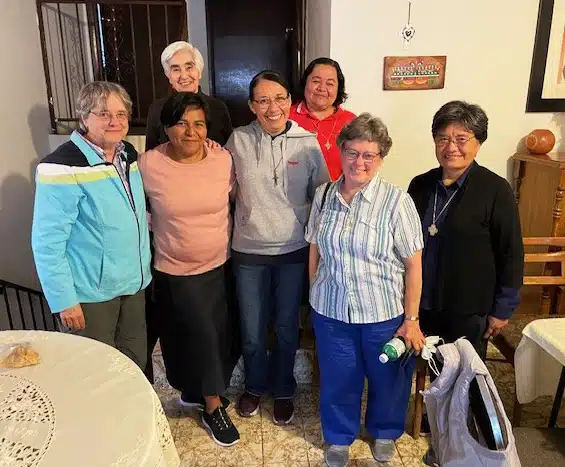
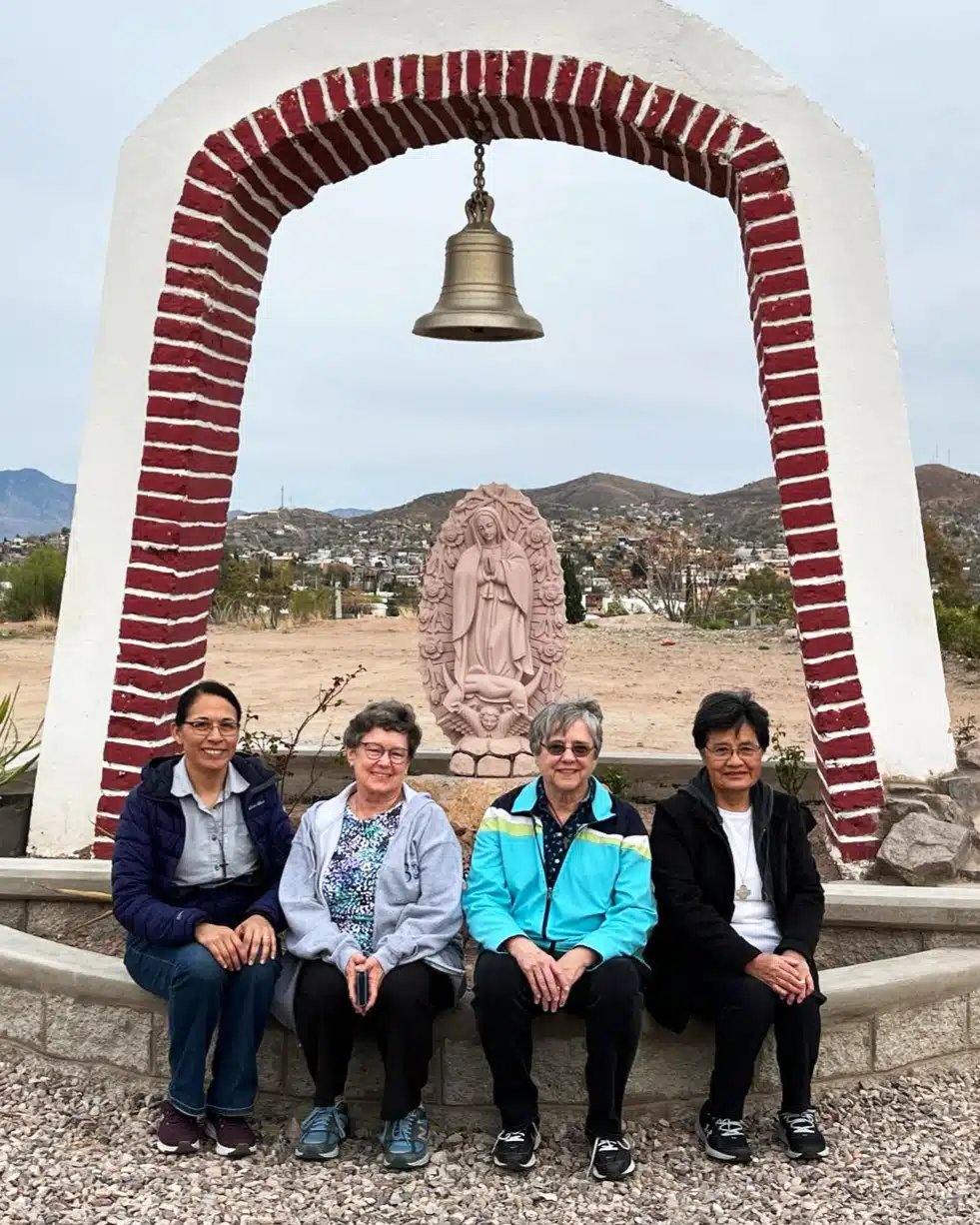
From March 4-April 4, 2024, Sister Jacinta served with the Kino Border Initiative, a ministry begun in 2009 to offer humanitarian assistance to migrants on the border of Nogales, Arizona and Nogales, Sonora, Mexico. Sister Jacinta learned of the ministry while she was on sabbatical in Tucson, Arizona in 2023. She applied for a Hilton Foundation grant to spend a month on the border.
“Migrants come to the border and ask for asylum. Our government has had a system in place for decades for these people to tell their story to a judge,” Sister Jacinta said. “Now, the migrants have to wait 6-8 weeks before they can meet with a judge. You have to be in line at the border when your case is called.”
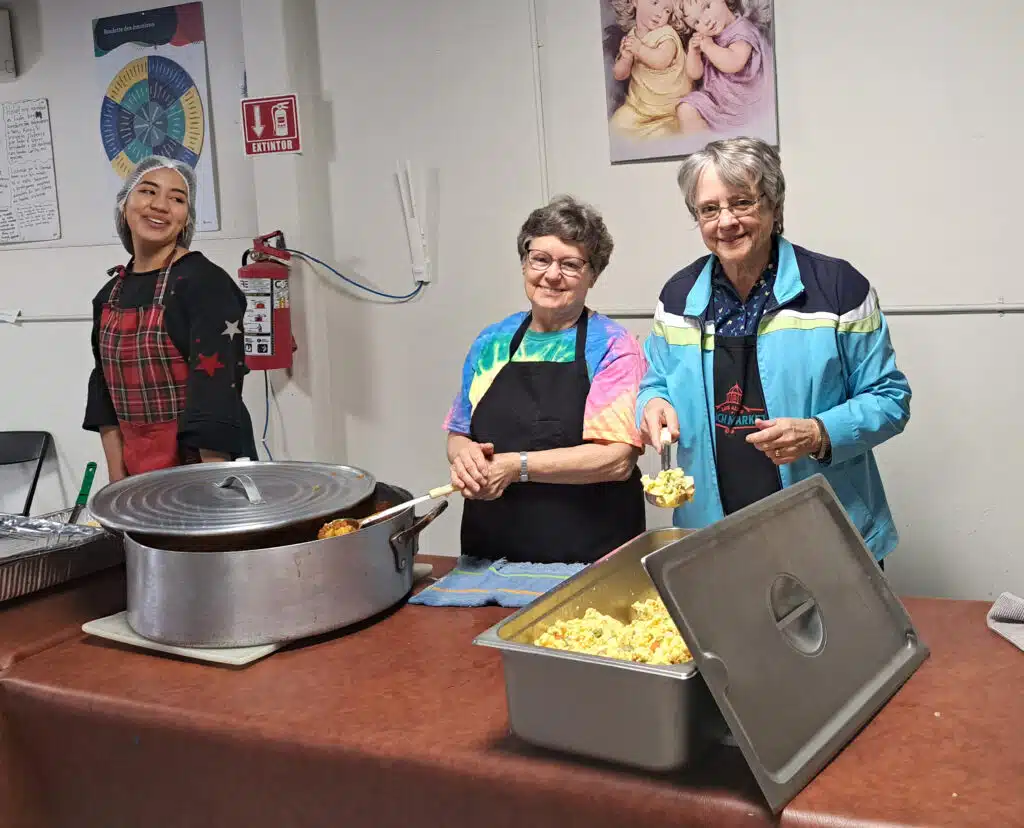
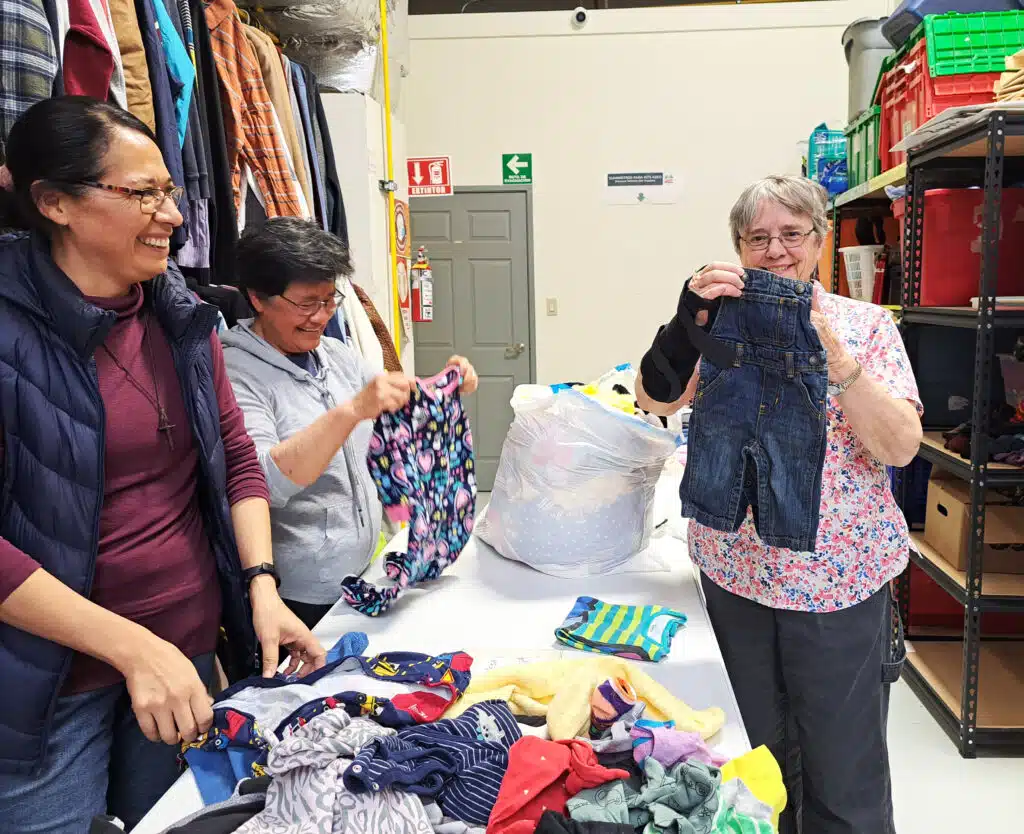
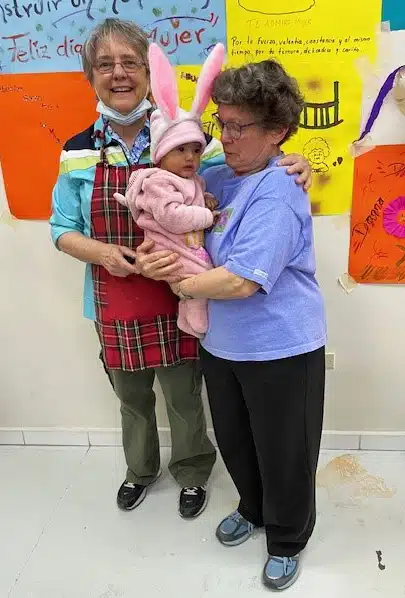
The Kino Border Initiative offers hot meals for the migrants. Up to 85 people can stay at their shelter in Mexico for 10 days. A social worker and a psychologist listen to their stories, and social workers try to find them shelter and a job for the weeks they must wait. There is a lawyer who explains the asylum process to them. There is a medical facility, and a play area for the children, Sister Jacinta said.
“A lot of the migrants awaiting asylum are from Mexico, El Salvador, Guatemala and Honduras, with a few from Haiti, Cuba and Ghana,” she said. “These people come through tremendous suffering to get to the border. They only leave their home countries because of poverty, drug cartels and fear of violence. They would do anything to protect their children. The journey is not easy. If you travel between Panama and Colombia, you have to pass through the Darien Gap, which is a horrible jungle area.”
The Darien Gap is considered one of the most inhospitable regions in the world, and prone to drug and human trafficking.
Kino provides 300 meals twice a day, with the rest to people staying in other settlements, or the homeless in the area, Sister Jacinta said. She helped in the kitchen, cutting up tomatoes, onions, even a cow’s stomach to serve during meals. They served a lot of refried beans and tortillas.
“I would do anything to make them smile,” she said.
In 2020, Sister Jacinta served 11 months at the border in Matamoros, Mexico, but that was a medical clinic. Nogales offers a broader array of services. Another difference is, in 2020 the border was closed. Now, there are a small number of migrants who are allowed in, but they have to prove they were threatened in their homeland. Sister Jacinta believes more migrants would be granted asylum if the people making the decisions experienced just one week of what the migrants go through.
One common thread between her service in 2020 and 2024 – both presidential election years – is that the plight of migrants is politicized, Sister Jacinta said.
“They are described as ‘pouring in,’ part of an ‘invasion,’ they are ‘taking our jobs,’” she said. “Calling it a crisis makes us want to fight against it. This is probably what our ancestors of Irish and Italian descent faced when they came to this country.”
Making it more difficult for migrants to receive asylum increases the cartel’s business, Sister Jacinta said.
“The cartels know people get turned away at the border. They say, ‘We’ll get you across for $10,000.’ They know the people are desperate and vulnerable for good news. There is a lot of drug trafficking, human trafficking and human smuggling.”
Sister Jacinta said she doesn’t speak enough Spanish to serve full time at the border. She is serving with Catholic Charities in Owensboro, which helps with disaster relief and legal documentation for refugees and migrants.
She believes any reading of the Gospels should impel people to help migrants.
“There is a quote from Saint John Chrysostom that says, ‘If you cannot find Christ in the beggar at the church door, you will not find him in the chalice,’” she said.
Sister Jacinta was inspired by Pope Francis’ words released June 3, 2024, in advance of the World Day of Migrants and Refugees on Sept. 29. He equated the biblical narrative of Exodus, with the Israelites’ long journey from slavery to freedom, with the stories of migrants today.
“Migrants often flee from oppression, abuse, insecurity, discrimination and lack of opportunities for development,” Pope Francis said. “Similar to the Jews in the desert, migrants encounter many obstacles in their path: They are tried by thirst and hunger; they are exhausted by toil and disease; they are tempted by despair.”
Yet, with every exodus, the pope said, “God precedes and accompanies his people and all his children in every time and place.”
“Many migrants experience God as their traveling companion, guide and anchor of salvation” and consolation, he wrote. “Thanks to him, there are good Samaritans along the way.”
God also “identifies himself with men and women on their journey through history, particularly with the least, the poor and the marginalized,” Pope Francis wrote. “For this reason, the encounter with the migrant, as with every brother and sister in need, is also an encounter with Christ.”
Sister Jacinta recommends the following books to better understand migrants and refugees:
- Voices of the Border, by Tobin Hansen and María Engracia Robles Robles, ME
- Soldiers and Kings, by Jason De Leon
- The Land of Open Graves, by Jason De Leon
- City of Thorns, by Ben Rawlence
- Dear America: Notes of Undocumented Citizens, by Jose Antonio
- My Fourth Time, We Drowned, by Sally Hayden
- The Devil’s Highway, by Luis Alberto Urrea
- Crossing the Line: Finding America in the Borderlands, by Sarah Towle
- Cobalt Red: How the Blood of the Congo Powers Our Lives, by Siddharth Kara
Comments