A child of the war
Sister Rita was born in Louisville in 1926, the fifth child of Leo and Rudina Klarer, who would eventually have eight children. Sister Rita is the only one of the children still living.
“I could easily say my first memory was death, my little brother Jimmy,” who died before his first birthday, she said. Her grandfather lived with the family and he died when she was in the 7th grade, then her father died the next year, at age 46. Also during that year, Sister Rita had a severe case of streptococcus, and the doctor told her parents her only hope for survival was the experimental drug sulfanilamide. The drug, and a lot of prayers, cured her.
It seemed the Klarer family could not escape tragedy. During Sister Rita’s freshman year of high school, her older brother Bud died following an operation. World War II was ongoing at this time and both her brothers Bill and Rudy served in battle. Rudy was on a football scholarship at the University of Tennessee and played in the Sugar Bowl as a sophomore before enlisting in the service. He was killed in combat in June 1945, earning the Silver Star for bravery, as he died protecting the lives of the men under his command. His No. 49 is one of seven numbers retired by the University of Tennessee.
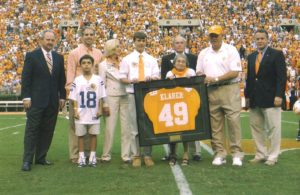
Sister Rita holds the framed jersey of her brother, Rudy Klarer, as she stands next to former University of Tennessee head coach Phil Fulmer the day her brother’s jersey was retired. Rudy Klarer was killed in battle during World War II.
Sister Rita earned a scholarship to Nazareth College in Louisville (now Spalding University), but with her mother having to take over the family building supply business, she thought perhaps she should drop out and help with the business. Her brothers urged her to continue her education and she earned her degree. “I think I became a support for my mother,” she said.
For a few years, Sister Rita was thinking about becoming a sister. “I was taught by the Sisters of Charity in high school and college, but I was taught by Ursulines in elementary school at St. Columba,” she said. “I fell in love with the Ursulines. I liked every teacher I had at St. Columba.”
“No one expected me to become a nun,” she said. “When I told some of my college friends, they placed bets on how long I’d last. Maybe it’s time for me to collect.”
She was one of six postulants entering in February 1946, and they referred to themselves as the “six Jell-Os.” She was “lime,” because she was the sixth. Her lone remaining classmate is Sister Mary Irene Cecil, who was orange.
Comments