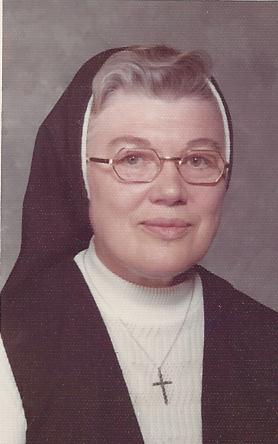
Irena, born June 6, 1924, was the only daughter of blacksmith Basil Wasylina and his wife, Anna, residents of Duliby, Stryj, in Polish Ukraine. Irena had two brothers, Peter, also a blacksmith, and
Nicholas, a cobbler. She was baptized and confirmed in the Byzantine Rite at St. Basil Church and grew up in a faith-filled family. Her father died of cancer when Irena was eight. Irena was in second grade. With the coming of the Nazis in 1939, she was forced to work in a factory making cord wood, ending her education before completing seventh grade. She considered herself fortunate because she was allowed a daily bonus of wood to take home for firewood.
In 1942, returning from Mass one morning, Irena found her mother waiting for her with an order for her to be prepared to board a train bound for a German work camp in Austria. From the train, Irena saw her mother for the last time, and by 1944 would never hear from her again. In Austria, the Germans lined up the workers who were then picked at random by those who had requested workers. Irena had the God-graced good fortune to be chosen by a good Catholic farmer, Johann Stieglebauer. For the next eight years, through the end of the war, Irena worked with the Stieglebauers cutting hay, tending the farm, learning the German language, and caring for the baby, Rosa, together with the other Stieglebauer children: Fritz, Hanzel and Pepi.
Though Irena’s joyful nature survived the war, she experienced tragedy and real danger. She learned that she had lost both brothers in the war, and that she almost lost her mother when she was interred at Auschwitz. Although her mother was later released, she had allowed herself to be transported to the camp in the place of the “other” Anna Wasylina, giving that unknown Anna a chance to escape. At the war’s end, Irena herself narrowly escaped capture, at the hands of the returning Bulgarian and Russian soldiers, by hiding under the back staircase and fleeing through hayfields and the neighboring hills.
In 1950, Irena knew it was time to move on. She contacted The Catholic Relief Services and signed to come to America. When she heard she was coming to Mount Saint Joseph Academy, she made it abundantly clear that she was not going to school … she was a grown woman and was coming to work. She arrived at the Mount, sincerely welcomed by all the Sisters. Sister Casimir Czurles, who spoke Irena’s native language, served as translator and teacher of English. Irena already spoke four languages. The other refugees who arrived with her remained our guests for several months until they found employment in their professional areas in cities like Chicago. One of the women became seriously ill and died during her short stay at the Mount. Her adult daughter then left the Mount to be with the friends she had made among the refugees with whom she had come to Mount Saint Joseph.
After three years living at the Mount, Irena went to work in a factory in St. Louis as a way to experience life in America outside a convent and help her to test the validity of her desire to become an Ursuline. Sister Victoria Brohm, who was missioned at Seven Holy Founders in Affton, became her staunch support during that time. The entire Brohm family adopted Irena as did the parents of Sister Mary Agnes VonderHaar. Irena was surrounded by this deep love for the rest of her life. She claimed Sister Mary Clarentia Hutchins and her brothers Henry and Xavier; and Sister Mary Edgar and the Warren family in that same circle of special love.
In 1953, Irena appealed to Rome for permission to leave the Eastern Rite and join the Latin or Roman Catholic Church that would open the door for her to enter the Ursuline community. August 14, 1954, she received the habit and the name Sister Ann Victoria; made temporary vows August 14, 1956; final vows August 15, 1957. To celebrate her 25th Jubilee, the community gifted her with a month’s visit to Austria with the Stieglebauer family and other parts of her homeland.
Sister’s ministries included 29 years in the dairy at the Motherhouse; two years at St. Teresa, Grants, N.M., in outreach to the sick and shut-ins; a short time at St. Columba in Louisville as a housekeeper. With declining health, Sister moved into Saint Joseph Villa in 2002. Her sense of humor and patient suffering never kept her from singing “Edelweiss,” “Stille Nocht,” Marian hymns and Irish Rovers.
Sister Ann Victoria died October 12, 2010. Following the Mass of Resurrection Thursday October 14, with Rev. Ray Goetz as celebrant, Sister’s remains were taken in solemn procession to the Motherhouse Mount Saint Joseph cemetery for burial.